React native app development is one of the most cost-effective ways to ship iOS and Android apps from a single codebase, but "cost-effective" doesn't mean cheap. In our client engagements, depending on feature scope, team location, and backend complexity, a React Native project can run anywhere from $25,000 for a stripped-down MVP to well over $250,000 for an enterprise-grade application. This guide breaks down exactly what moves those numbers, how long each type of project actually takes, and what to look for when choosing a development partner.
Key Insight In our client engagements, depending on feature scope, team location, and backend complexity, a React Native project can run anywhere from $25,000 for a stripped-down MVP to well over $250,000 for an enterprise-grade application.
In This Article, You'll Learn
How Much Does React Native App Development Cost?
What Affects Your React Native Development Budget?
React Native App Development Timelines by Project Type
React Native vs Flutter: Which Should You Choose?
Where Azure and Power Platform Fit Into Mobile Projects
Eager to discuss about your project?
Share your project idea with us. Together, we’ll transform your vision into an exceptional digital product!
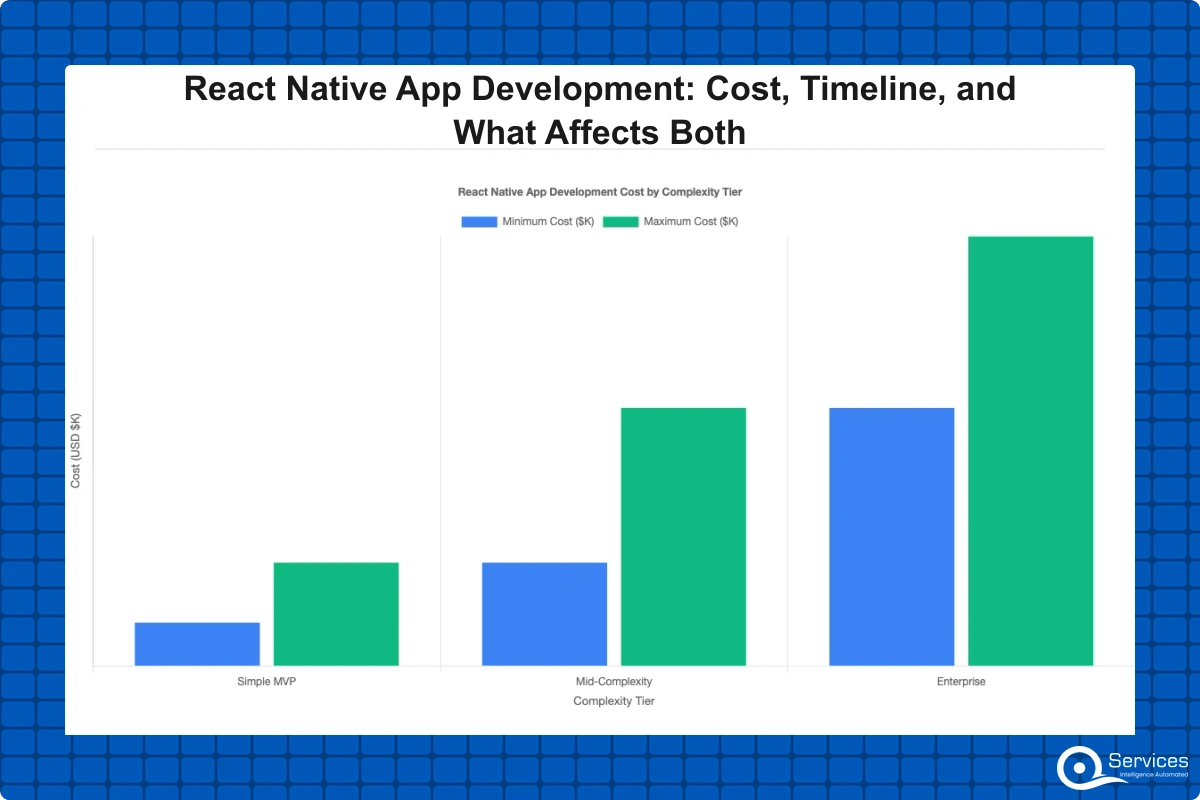
In our experience, React Native app development typically costs $25,000–$60,000 for simple apps, $60,000–$150,000 for mid-complexity projects, and $150,000–$250,000+ for enterprise applications. Those ranges shift based on team geography, feature scope, backend complexity, and compliance requirements. Timeline follows a similar pattern: 8–14 weeks for MVPs, 4–8 months for full-featured apps, and 9–18 months for enterprise builds.
Simple Apps: $25,000–$60,000
At this level you're typically looking at 3–4 core screens, a single user role, basic authentication, and a REST API consuming data from an existing backend. Think a company directory app, a simple booking flow, or a read-only dashboard. Development time usually runs 8–14 weeks with a team of 2–3 engineers.
React Native Expo accelerates this tier significantly. Expo's managed workflow handles native build configuration automatically, cutting project setup from 3–5 days to a few hours. For straightforward consumer apps with no custom native code, Expo is worth evaluating from day one.
Mid-Complexity Apps: $60,000–$150,000
This is where most real-world projects land. You get multiple user roles, push notifications, offline support, payment processing, third-party integrations (CRMs, ERPs, maps), and custom UI components. Expect 4–8 months of development with a team of 4–6 people. A healthcare patient portal or a field-service management app typically sits in this range.
Enterprise React Native Apps: $150,000–$250,000+
At the enterprise end, you're dealing with complex state management, biometric authentication, real-time data sync, compliance requirements (HIPAA, PCI-DSS), and integration with legacy systems. These projects rarely finish in under 9 months and often require dedicated QA engineers, security reviews, and multi-region backend infrastructure.
What Affects Your React Native Development Budget?
Understanding the cost tiers is useful, but knowing why a project lands where it does is more useful. Here are the factors that move your number most.
Team Location and Hourly Rates
In our experience, a React Native developer in Eastern Europe typically bills $40–$75/hour, in South Asia rates drop to $25–$50/hour, and North American or Western European developers run $100–$180/hour. For a 2,000-hour project, that difference alone can be $50,000–$260,000. Offshore teams can work well, but time-zone gaps and communication overhead add hidden costs that pure rate comparisons don't capture.
Key Insight In our experience, a React Native developer in Eastern Europe typically bills $40–$75/hour, in South Asia rates drop to $25–$50/hour, and North American or Western European developers run $100–$180/hour.
App Complexity and Native Modules
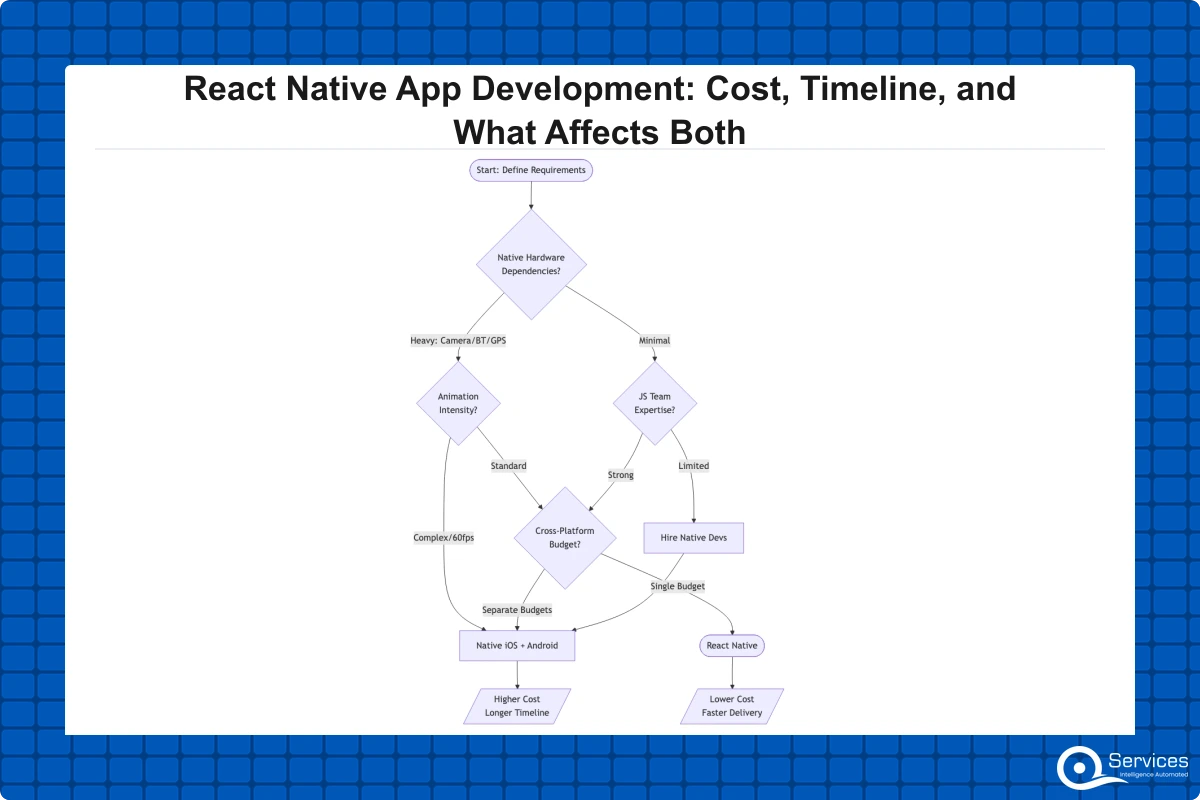
Every feature has a real cost. In our experience, a basic push notification setup takes 2–4 hours, a fully custom in-app chat system takes 80–120 hours, and real-time location tracking with geofencing adds another 60–80 hours. Most apps can stay in JavaScript, but Bluetooth hardware integration, certain camera features, and AR capabilities require writing native code in Swift or Kotlin. Native module development costs 2–3x more than pure React Native work and requires engineers who know both ecosystems.
Backend, APIs, and Cloud Infrastructure
React Native handles the client layer. It still needs a backend. If you're building a new API from scratch, add 30–50% to your mobile development cost. Many enterprise React Native apps run on Azure backend services: Azure App Service for APIs, Azure SQL or Cosmos DB for data, and Azure Active Directory for identity. Working with an experienced azure consulting services provider during the backend design phase prevents costly architectural rework later. The decisions made in week two (database choice, auth provider, caching strategy) are very hard to reverse in month six.
For teams concerned about ongoing running costs as usage grows, our Azure cost optimization guide covers nine specific levers that keep cloud bills predictable.
Third-Party Integrations
Connecting to payment gateways, analytics platforms, or enterprise systems adds meaningful time. Each integration requires reading vendor documentation, handling edge cases, and thorough testing across environments. Budget 20–40 hours per major integration as a baseline, more if the vendor API is poorly documented or has rate-limiting behavior that affects mobile UX.
QA, Testing, and App Store Submission
Apple's App Store review process can add 1–2 weeks on its own. Thorough QA across device sizes, OS versions, and network conditions is not optional for a stable app. Automated testing suites for React Native typically take 60–100 hours to build but pay back that investment quickly on apps with ongoing feature development. For regulated industries, compliance testing is a separate line item that many initial estimates omit.
React Native App Development Timelines by Project Type
Budget and timeline are inseparable. Here's what realistic delivery looks like, without the optimistic assumptions that often appear in vendor proposals.
MVP Timelines: 8–14 Weeks
An MVP should ship the one core user flow that validates your product assumption. Eight weeks is achievable with a disciplined scope. Fourteen weeks usually means scope expanded in week three. Using React Native Expo's managed workflow trims native build setup and keeps MVPs closer to the 8–10 week mark for apps without complex native dependencies.
Full-Featured App Timelines: 4–9 Months
A production-ready app with all planned features, thorough testing, and App Store and Play Store approvals typically takes 4–9 months. The wide range reflects integration complexity. An app that connects to five enterprise systems takes considerably longer than one that talks to a single clean API. Building automated CI/CD pipelines through azure devops consulting services at this stage reduces deployment friction significantly on every subsequent release.
Enterprise App Timelines: 9–18 Months
Enterprise projects include procurement cycles, compliance reviews, internal approval workflows, and phased rollouts to user groups. The technical build might take 6 months; the organizational scaffolding around it adds the rest. Plan for this in your roadmap from the first stakeholder conversation. For a broader view of how architecture decisions affect overall timelines, see our enterprise application development guide.
React Native vs Flutter: Which Should You Choose?
This comparison comes up in nearly every mobile project scoping conversation. Here's a direct answer.
Performance and Production Use Cases
React Native uses JavaScript and a bridge to communicate with native components. For most business applications, this is not a performance bottleneck. Flutter compiles to native ARM code, which gives it an edge in graphics-intensive scenarios like games or heavily animated interfaces. For forms, dashboards, e-commerce flows, and enterprise tools, both frameworks perform comparably in production.
React Native's official documentation notes that the framework runs in production at Facebook, Instagram, and Microsoft at scale. Zomato, one of the largest food delivery platforms in Asia, also uses React Native for its customer app, handling tens of millions of daily sessions. That level of production validation matters when evaluating enterprise readiness.
Ecosystem, Learning Curve, and Team Fit
If your team already knows JavaScript and React, React Native is the faster onboarding path. Flutter uses Dart, which most developers don't know, adding 4–8 weeks of ramp-up per engineer. The react native app development github community is substantially larger, which means more open-source packages, more Stack Overflow answers, and faster problem resolution. For a full framework-by-framework breakdown, our React Native vs Flutter vs Xamarin comparison covers trade-offs by project type.
Where Azure and Power Platform Fit Into Mobile Projects
React Native handles the client layer. The backend is a separate decision that significantly affects your total project cost, scalability ceiling, and long-term maintenance burden.
Azure as a Mobile Backend
Many enterprise React Native apps sit on top of Azure infrastructure. Azure Notification Hubs for push, Azure Active Directory B2C for consumer identity, Azure API Management as a gateway layer, and Azure Cosmos DB for globally distributed data are common choices. If your organization already uses Microsoft infrastructure, this cuts integration time considerably and gives your security team a familiar compliance surface.
An azure architecture review before development begins can identify whether existing on-premise systems need azure app modernization work before they can support a mobile integration layer. Partnering with an azure migration partner for this phase often saves more in avoided rework than the assessment itself costs. Teams migrating from on-premise data to cloud-backed mobile backends benefit specifically from azure cloud migration services designed for phased transitions rather than big-bang cutovers.
Power Platform and Workflow Automation
Some React Native apps serve as the mobile front end to broader Power Platform workflows. A field technician app might capture job data through React Native, trigger an approval flow via power automate consulting work done earlier in the project, and write results to Dataverse. This architecture is common in logistics and facilities management. When built correctly, it reduces custom backend development by 30–40% compared to a fully custom API. Power apps development services can fill specific workflow gaps without adding custom code to the React Native codebase.
Key Insight When built correctly, it reduces custom backend development by 30–40% compared to a fully custom API.
How to Choose a React Native Development Partner
The technical criteria matter less than most buyers expect. Every reputable shop knows how to build with React Native. What separates good engagements from poor ones is process discipline.
Technical Portfolio and Domain Experience
Ask to see published apps, not just screenshots. Download them. Check the reviews, the performance on a mid-range Android device, and how recently they were updated. Ask specifically about their testing approach, code review process, and how they handle native module requirements when they surface mid-project. A partner who has shipped apps for healthcare or financial services clients understands compliance constraints that general-purpose shops often don't.
According to Statista's mobile app market research, global mobile app revenue is projected to exceed $935 billion by 2025. The partner you choose shapes whether your share of that market becomes an asset or a liability.
Process, Scope Management, and Communication
Insist on weekly demos of working software, not status reports. Understand exactly who owns QA. Get clarity on how change requests are priced, because scope will change on every meaningful project. A partner who can't answer these questions clearly before you sign is not going to answer them clearly during a stressful sprint. For a broader set of evaluation criteria that apply to any technology engagement, our custom software development company evaluation guide covers 10 criteria that translate directly to mobile project selection.
Key Takeaways
In our experience, React Native app development typically costs $25,000–$60,000 for simple apps, $60,000–$150,000 for mid-complexity projects, and $150,000–$250,000+ for enterprise applications.
Understanding the cost tiers is useful, but knowing why a project lands where it does is more useful.
Budget and timeline are inseparable.
This comparison comes up in nearly every mobile project scoping conversation.
React Native handles the client layer.
Conclusion
React native app development costs are predictable when you understand the variables. In our experience, a simple MVP starts around $25,000 and takes 8–14 weeks, a mid-complexity production app runs $60,000–$150,000 over 4–8 months, and enterprise projects scale from $150,000 to $250,000+ with timelines of 9–18 months.
The factors that move the number most: team geography, feature complexity, backend infrastructure choice, compliance requirements, and whether you need native modules. React Native is a proven choice for most business applications, and the framework is mature enough for enterprise-scale deployments at companies like Zomato and Microsoft. What it won't do is compensate for vague scope, a poorly designed backend, or a partner who manages scope reactively instead of proactively.
Ready to get actual numbers for your project? Get a React Native Project Quote from QServices. We'll give you a detailed estimate based on your real requirements, flag the cost drivers before they become surprises, and connect mobile architecture decisions to your broader Azure and Microsoft platform strategy.
Co-Founder and CTO, QServices IT Solutions Pvt Ltd
Rohit Dabra is the Co-Founder and Chief Technology Officer at QServices, a software development company focused on building practical digital solutions for businesses. At QServices, Rohit works closely with startups and growing businesses to design and develop web platforms, mobile applications, and scalable cloud systems. He is particularly interested in automation and artificial intelligence, building systems that automate routine tasks for teams and organizations.
Yes. React Native is a mature, production-proven framework used by companies like Facebook, Instagram, Microsoft, and Zomato to build iOS and Android apps from a single JavaScript codebase. It supports most business app requirements including authentication, push notifications, offline storage, and third-party API integrations. For apps requiring deep hardware access (Bluetooth, AR), native modules can extend React Native’s capabilities.
For most business applications, React Native and Flutter are comparable in performance. React Native is the better choice if your team already knows JavaScript or React, since the onboarding time is significantly shorter. Flutter has a slight edge in graphics-intensive apps due to its native ARM compilation. The deciding factor for most enterprise teams is team expertise and existing tech stack, not raw framework performance.
React Native app development costs range from $25,000–$60,000 for simple apps, $60,000–$150,000 for mid-complexity projects with multiple integrations, and $150,000–$250,000+ for enterprise applications with compliance requirements and legacy system integrations. The biggest cost drivers are team location (offshore vs. nearshore vs. onshore rates), feature complexity, backend infrastructure, and whether native modules are required.
Yes. Zomato, one of the largest food delivery platforms in Asia with tens of millions of daily active users, uses React Native for its customer-facing mobile app. This is a commonly cited example of React Native performing reliably at significant scale in a production environment, addressing concerns about whether the framework is suitable for high-traffic enterprise applications.
Learning the fundamentals of React in 2 months is realistic with focused, daily practice. You can build simple components, manage state with hooks, and connect to APIs in that timeframe. However, becoming proficient enough to contribute to a production React Native app typically takes 4–6 months, particularly when accounting for native build tooling, navigation libraries, and platform-specific behavior differences between iOS and Android.
React Native development timelines depend on project complexity. Simple MVP apps take 8–14 weeks. Full-featured production apps with multiple integrations take 4–9 months. Enterprise applications with compliance requirements, legacy system integrations, and phased rollouts typically take 9–18 months from kickoff to full deployment. Using React Native Expo for managed builds can reduce MVP timelines by 2–3 weeks.
The five biggest cost drivers in React Native development are: (1) team location and hourly rates, which can swing total cost by $50,000–$200,000 for the same scope; (2) feature complexity and custom UI requirements; (3) backend and API development, which adds 30–50% to mobile costs when built from scratch; (4) third-party integrations at 20–40 hours each; and (5) whether native modules are required, which costs 2–3x more than pure JavaScript development.
When PDF text extraction drops the spaces between words, AI agents can’t find facts that are right there. How we found it in Azure AI Foundry and fixed it.
Pint AE explained for UAE finance teams with one sample invoice: see which fields come from your ERP, which go missing, and how to test before go-live.
Days sales outstanding explained for CFOs: the formula, worked examples, named industry benchmarks, and why seasonal sales distort DSO. See what moves it.
Eager to discuss about your project?
Share your project idea with us. Together, we’ll transform your vision into an exceptional digital product!
When PDF text extraction drops the spaces between words, AI agents can’t find facts that are right there. How we found it in Azure AI Foundry and fixed it.
Pint AE explained for UAE finance teams with one sample invoice: see which fields come from your ERP, which go missing, and how to test before go-live.
Days sales outstanding explained for CFOs: the formula, worked examples, named industry benchmarks, and why seasonal sales distort DSO. See what moves it.
QServices Inc. undertakes every project with a high degree of professionalism. Their communication style is unmatched and they are always available to resolve issues or just discuss the project.
Turn the Microsoft Licenses
You Already Own Into an AI Workplace
Join our live webinar on Sept 24 and see five ways to automate meetings, approvals, and